

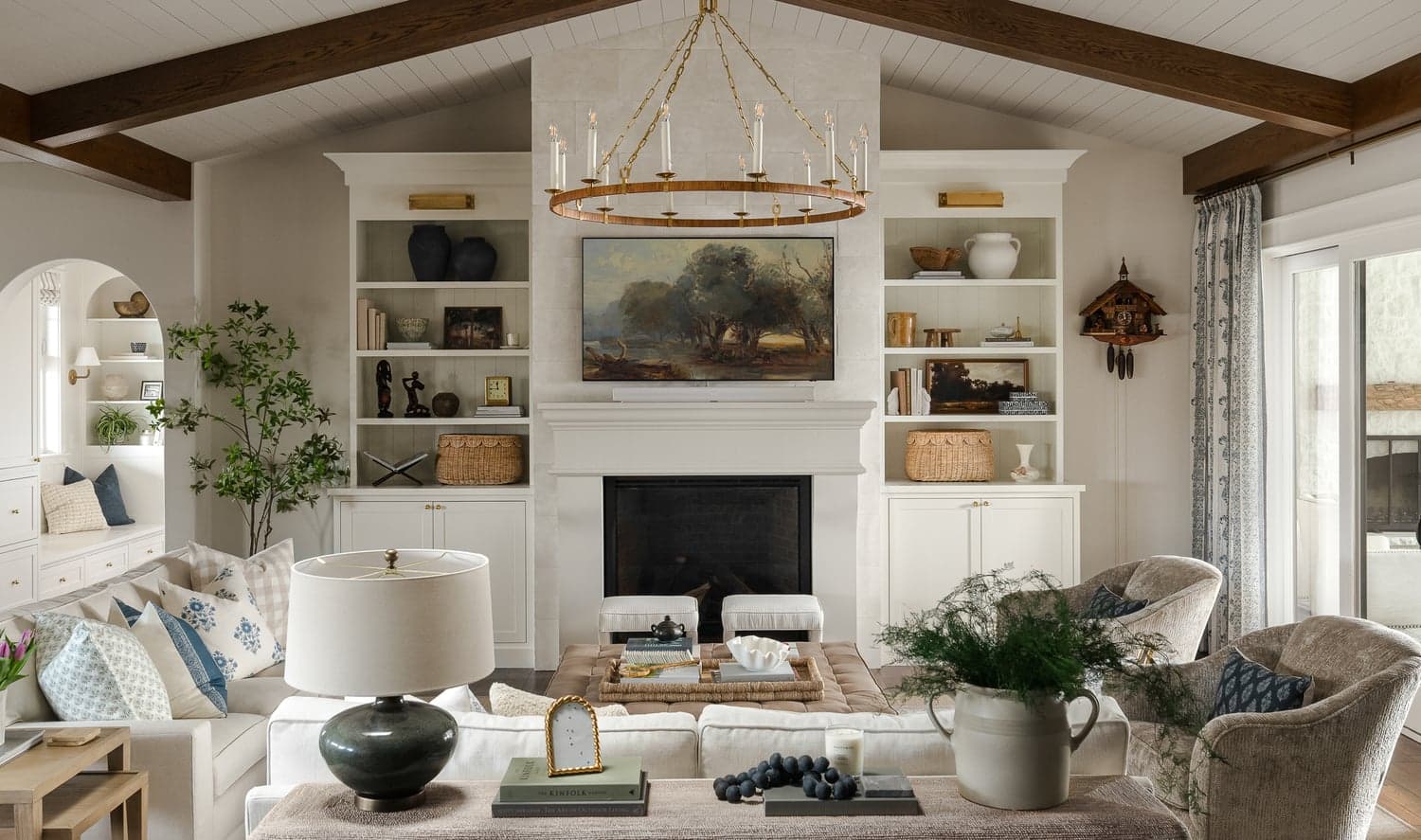
What is cast stone?
A material guide for homeowners, designers, architects and builders planning a fireplace surround.
Cast stone is a refined kind of architectural precast concrete, made to look like natural cut stone. If you’ve been looking at precast concrete fireplace mantels, cast stone is the finer, finish-grade version. It’s made mainly of mineral materials, lighter and less expensive than solid stone, and can be molded to custom profiles. Oltre casts its fireplace surrounds to order in Salem, Oregon, made with a glass-fiber-reinforced (GFRC) premix rated at 11,000 PSI, on a six-week lead time.
What cast stone is made of.
“Cast stone” describes a category, not a single recipe. At its core it is a precisely graded mix of stone aggregate, cement, and mineral pigment, cast in molds and cured to reproduce the look of cut limestone or sandstone. What separates cast stone from ordinary concrete is intent: it is a finish-grade architectural material judged on appearance (color consistency, surface texture, and the crispness of an edge) rather than on raw structural capacity.
Because it is poured into a mold, cast stone can reproduce ornate classical profiles like the Louis XV or clean modern reveals like the Trento with equal precision, and it can be sized to a specific firebox opening. That combination (the look of cut stone, custom geometry, and a fraction of the weight and cost of solid stone) is why cast stone is a common choice for fireplace surrounds in residential work. Before you pick a model, check your firebox measurements.
Three kinds of cast stone.
The term covers several formulations that behave quite differently on a job site:
GFRC (glass-fiber-reinforced concrete)
GFRC replaces internal steel and some of the mass with alkali-resistant glass fibers mixed throughout the material. The result is a thin, strong shell with high flexural strength, dramatically lighter than solid cast stone, which makes it easier to crate, ship nationwide, and install without heavy structural framing. This is the formulation Oltre uses for its cast stone fireplace surrounds.
Cement-based (dry-tamp / wet-cast) cast stone
Traditional cast stone is a dense, vibrated mix that relies on its full thickness for strength. It produces a beautiful, weighty piece but can be heavy enough to require reinforced framing and more involved installation, a real consideration on an upper floor or an interior wall.
Limestone-aggregate cast stone
Many makers grade their mix around crushed natural limestone so the cast surface reads as genuine limestone in tone and grain. This is about appearance and finish rather than a different structural system; a limestone-aggregate mix can be produced as either traditional cast stone or GFRC.
Using cast stone near the fire.
Cast stone is a familiar fireplace surround material, alongside natural stone and brick. It is made mainly of mineral materials: cement, graded stone or sand, and mineral pigment. Oltre’s mix is Portland cement, graded quartzite sand, silica fume, an admixture, and alkali-resistant glass fiber. It has not been tested to ASTM E136, so the firebox or insert maker’s clearances and your local code decide placement.
Two practical points. First, follow the clearances in the firebox or insert manual for the surround and for any wood mantel or millwork beside it. Second, follow the install guide: the surround hangs on a hidden wood ledger, and stone bonded directly to a steel firebox that expands with heat is the most common cause of avoidable cracking.
Curing science and the 11,000 PSI rating.
Cast stone gains strength as the cement hydrates and cures over days and weeks, not minutes. Compressive strength, measured in pounds per square inch (PSI), is the headline number for how dense and durable the cured material is. Standard residential concrete runs roughly 2,500 to 4,000 PSI.
Oltre’s surrounds are made with a GFRC premix rated at 11,000 PSI. That number does real work. A denser body holds a crisp edge and shrugs off the chips that happen in handling and installation. Cast stone is naturally porous; ours is wet cast and ships sealed, so the surface has low porosity and stains struggle to set over a lifetime of use.
Cast stone vs. the alternatives.
How cast stone (GFRC) compares to the surround materials homeowners and specifiers weigh most often:
| Attribute | Cast stone (GFRC) | Natural limestone | Solid stone (granite / marble) | Precast concrete |
|---|---|---|---|---|
| Composition | Graded aggregate, cement, pigment, glass fiber | Quarried natural limestone | Quarried granite or marble slab | Structural concrete, coarse aggregate |
| Weight | Light (thin reinforced shell) | Heavy | Heaviest; often needs added support | Heavy |
| Cost (installed) | $$ (mid-range) | $$$ (high) | $$$$ (highest) | $$ (mid-range) |
| Design flexibility | High (molded to custom profiles) | Moderate (hand-carved, limited by block) | Low (cut from slab) | Low (structural finish, coarse detail) |
For a deeper, seven-material breakdown including marble, brick, tile, and wood mantels, see the fireplace surround material comparison. For real prices, see what a cast stone fireplace costs.