

Cast Stone Fireplaces in the Midwest
Each piece is handmade to order in Salem, Oregon, and takes six weeks to make. FedEx Freight then brings it to your Midwest project in 4 to 8 business days.
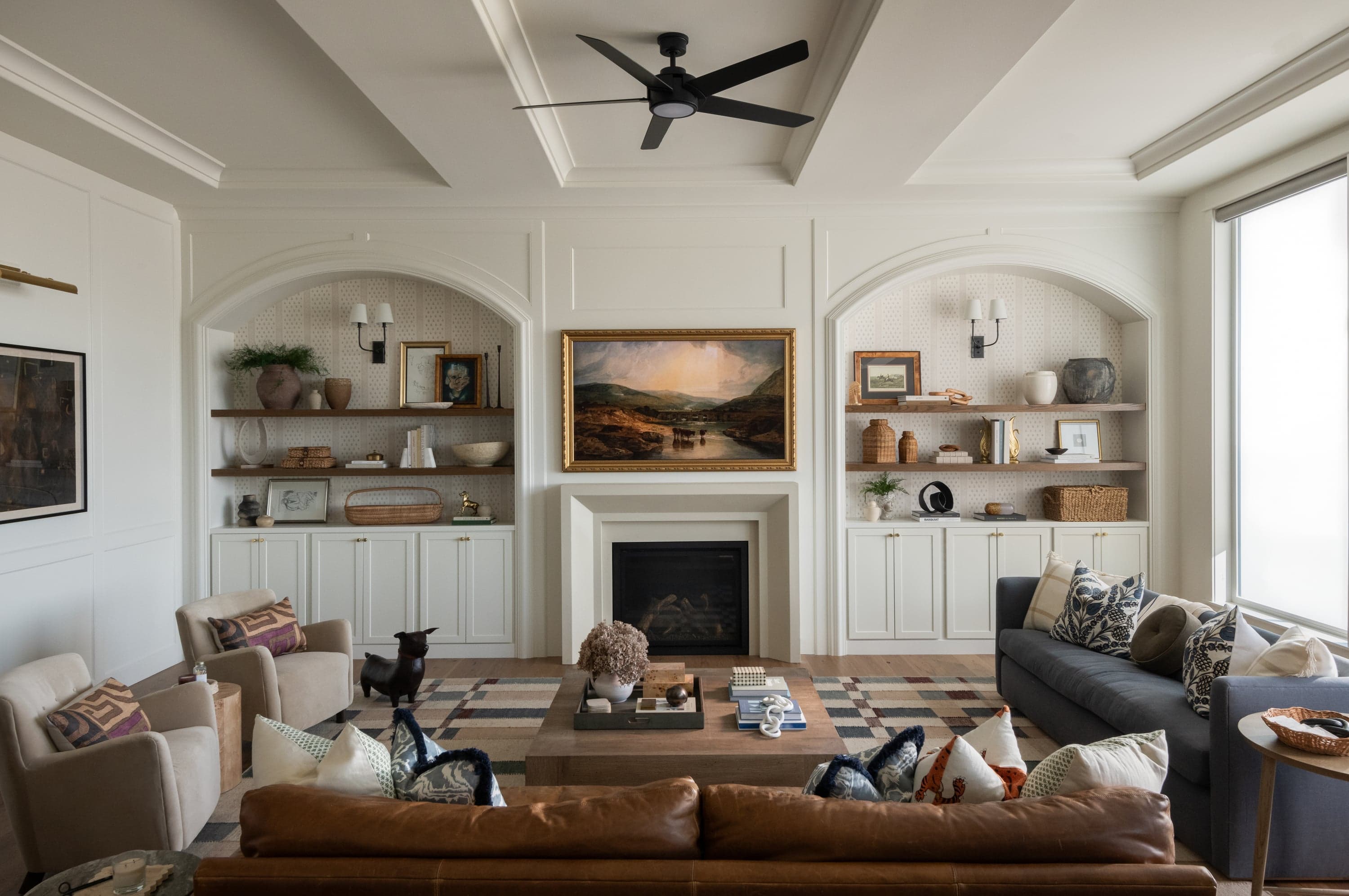
Each piece is handmade to order in Salem, Oregon, and takes six weeks to make. FedEx Freight then brings it to your Midwest project in 4 to 8 business days.
Oltre ships cast stone fireplace surrounds to Chicago, Detroit, Minneapolis, Cleveland, Indianapolis, Saint Louis, and the broader Midwest from Salem, Oregon. Production takes six weeks from the day your order is placed and paid. Freight then takes 4 to 8 business days. Prairie School, Tudor Revival, and Midwestern Modern interiors all suit cast stone.
The Midwest has produced more native architectural traditions than its modest reputation suggests: Prairie School, Chicago School, Tudor Revival, Lake Forest French Eclectic, the broader Midwestern lakefront style. Cast stone reads naturally in all of them.
Prairie School and the Frank Lloyd Wright tradition define the deeper Midwestern residential vocabulary across the Chicago North Shore, Oak Park, the broader Chicago suburbs, the Madison-to-Milwaukee corridor, and the Minneapolis lake district. Horizontal massing, art-glass details, and a substantial low-profile fireplace anchor are what people expect here. Cast stone surrounds in Wright-school proportions read as period-correct for the style.
Tudor Revival and French Eclectic, the Lake Forest, Hinsdale, Bloomfield Hills, Grosse Pointe, and Edina styles, work in heavier classical massing than Prairie School. Substantial fireplace surrounds with ornate limestone profiles are the default, and Oltre's Verona, Louis XV, and Newport profiles suit these contexts.
Midwestern Modern is the third style, common in the Chicago loft-conversion market, the Minneapolis lakefront new-construction belt, and the Saugatuck-to-Harbor-Country shoreline cottage market. It works in restrained palettes where the fireplace surround is often the single stone element in an otherwise minimal envelope.
The Midwest is a real freeze-thaw climate with sustained summer humidity. Cast stone handles both, and GFRC made with a premix rated at 11,000 PSI is better suited to freeze-thaw cycling than natural limestone.
Freeze-thaw matters most, especially in the upper Midwest (Minneapolis, Madison, Green Bay). Cast stone is naturally porous, but ours is wet cast and ships sealed, so the surface has low porosity. It handles this cycling without the joint spalling that affects soft natural limestone over decades. Indoors, freeze-thaw isn't a factor, so this mostly matters for outdoor pieces.
Great Lakes humidity comes next, along the Chicago lakefront, the Grand Rapids-to-Saugatuck shoreline, the Cleveland lake corridor and the Door County coast. Reseal every five years indoors and every year outdoors, lakefront or not.
There's also the humid Midwestern summer. Dense GFRC handles the seasonal cycle well, without the hairline cracking that can affect porous natural stone over decades.
We make every piece to order in Salem, Oregon. Production takes six weeks from the day your order is placed and paid. Freight then takes 4 to 8 business days. It ships crated by FedEx Freight, free on standard models anywhere in the contiguous 48 states. Need it sooner? Three-week production is available for 35% above list.
These profiles fit the home styles above. Each one is made to order in Salem, Oregon, and production takes six weeks.
Simple classical lines for transitional interiors on the Chicago North Shore and in Lake Forest and Bloomfield Hills.
See the Newport model →A substantial Italian-style design for Tudor Revival great rooms across the Lake Forest, Hinsdale, Grosse Pointe, and Edina belt.
See the Verona model →Baroque silhouette for higher-end French Eclectic projects in Lake Forest, Bloomfield Hills, and Indian Hill.
See the Louis XV model →A simple European design that suits Prairie School and Midwestern Modern interiors with restrained palettes.
See the Lucca model →Clean Parisian lines for higher-end Chicago Gold Coast and Minneapolis lakefront new construction.
See the New French model →Mediterranean profile that looks right in higher-end Lake Geneva, Harbor Country, and Door County summer-cottage tradition projects.
See the Amalfi model →We ship nationwide from Salem, Oregon. Pick another region below, or see all the areas we serve.