

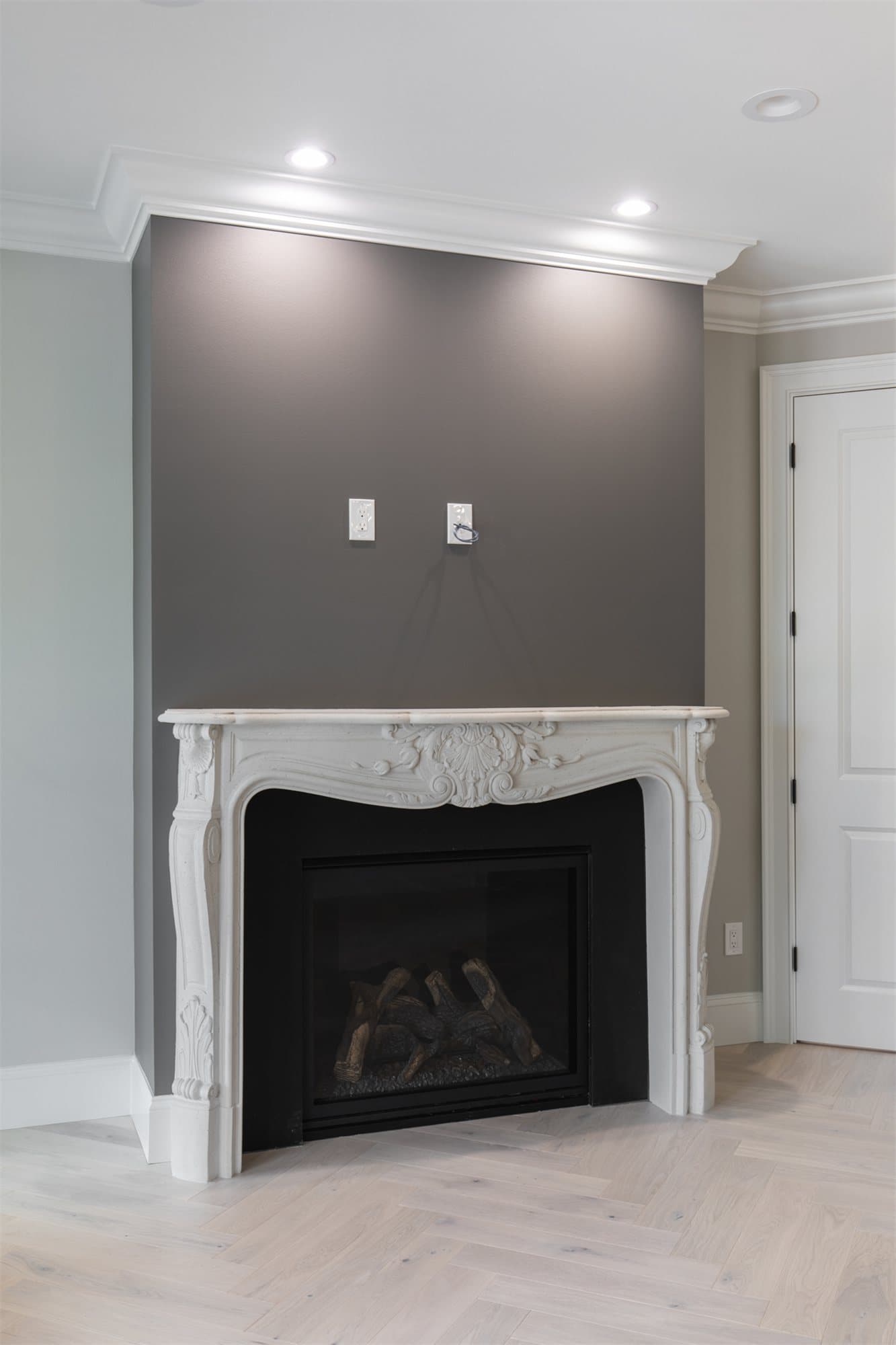
Fireplace mantel styles.
Contemporary to French — how the six mantel styles differ, and how to choose one your room can carry.
The right fireplace mantel style follows the room. Clean squared profiles suit contemporary and modern interiors, restrained classical lines suit transitional rooms, carved profiles with deep moldings suit traditional homes, simple shelf mantels suit farmhouse spaces, and curved French profiles suit European-inflected interiors. Cast stone reproduces all six styles in custom sizes.
Six styles, one decision.
A quick terminology note first: the mantel is strictly the shelf above the firebox; the surround is the full assembly — legs, header, and shelf — framing it. Buyers use the words interchangeably, and almost every “mantel” decision is really a surround decision.
The style question resolves faster than most people expect, because the room has usually already decided. Architecture, millwork, and floor tone narrow six recognized styles down to one or two candidates. Here is the map, weighted toward the contemporary and transitional work that dominates current specification.
| Style | Best for | Profile character | Material fit | Oltre model examples |
|---|---|---|---|---|
| Contemporary | New builds, open plans | Restrained lines, minimal molding, honed finish | Cast stone (honed), large-format porcelain | Newport, Amalfi |
| Modern minimalist | Architectural interiors | Planar, squared, shadow-line reveals | Smooth cast stone, concrete | Trento, Como |
| Transitional | Most remodels and mixed rooms | Light classical profile, quiet ornament | Limestone-look cast stone | Newport, Lucca, Vienna |
| Traditional / classical | Period homes, formal rooms | Carved moldings, pilasters, deep shelf | Cast limestone, natural limestone | Merano, Florenza, Meduri |
| Farmhouse | Informal, rustic-warm rooms | Simple shelf or squared surround, no carving | Cast stone shelf, brick facing | Mantel shelves, Trento |
| French / European | Estate-tier, European-inflected interiors | Curved legs, parlor or baroque silhouette | Cast limestone | New French, Louis XV, Verona |
Contemporary.
The best mantel for a contemporary home is a clean, restrained profile in a light natural-stone tone with a honed matte finish. Contemporary rooms reward subtraction: minimal molding, squared or gently stepped lines, and a surround that anchors the wall without announcing a period. The Newport is the most-specified example — restrained classical proportions that recede when the room is busy and read cleanly modern in a honed finish. The Amalfi takes the warmer route: a coastal Mediterranean profile whose limestone warmth pairs unexpectedly well with modern palettes — plaster, white oak, board-formed concrete.
Modern minimalist.
Modern minimalist goes further than contemporary: planar surfaces, squared edges, shadow-line reveals, and no ornament at all. The mantel becomes a mass, not a molding. In cast stone that is a smooth-finish surround like the Trento or Como — the two Oltre models offered in a smooth standard finish — where the material does the work the profile declines to do. Because cast stone is molded rather than carved, a minimal profile comes out crisp, seam-free, and dimensioned to the exact opening.
Transitional.
Transitional is the widest lane in current residential work: a light classical profile with the ornament dialed down, at home between a modern kitchen and a traditional dining room. The Newport crosses into this style effortlessly, which is why designers re-specify it so often. The Lucca brings a quiet European silhouette — warmth without ornament — and the Vienna sits between them with a softly stepped one-piece profile. If the room mixes eras, transitional is usually the answer.
Traditional / classical.
Traditional rooms call for carved profiles: crown moldings, pilastered legs, a deep shelf, and proportions substantial enough to hold a formal wall. This is where the three-piece statement surrounds live — the Merano, Florenza, and Meduri — each offering the classical look of traditional stonework with a clean, refined presence. For period renovation, a cast limestone profile can be dimension-matched to an existing original surround, which quarried stone rarely allows at comparable cost.
Farmhouse.
Farmhouse interiors want the mantel honest and unfussy: a chunky floating shelf over a stone or brick facing, or a plain squared surround with no carving. A cast stone mantel shelf delivers that look in a non-combustible material — no wood-clearance constraints above the firebox — cast to length and finished smooth or lightly textured. Where the room wants a full surround, the Trento’s simple smooth profile keeps the farmhouse restraint.
French / European.
French and European styles carry the most personality: curved legs, cartouche-ready headers, and silhouettes that trace back to Parisian apartments and provincial estates. The New French works the restrained end — clean Parisian apartment proportions for rooms that want the reference without the drama. The Louis XV is the baroque silhouette, specified where an estate-tier statement is the design intent. Between them, the Verona carries an Italian-inflected weight that anchors great rooms with heavy timber and stone.
How to choose.
Once the style is set, six practical checks confirm the specific model:
- Firebox size and clearances: the opening and the appliance’s clearance-to-combustibles spec set the minimum interior dimensions. Start here.
- Ceiling height: taller rooms carry taller, more substantial profiles; standard-height rooms favor restrained ones. An overmantel needs generous height above the shelf.
- Millwork: the surround should match the room’s trim language — carved profiles beside carved casings, squared profiles beside flat-stock modern trim.
- Stone color: confirm the finish tone against the wall color in your own light. Physical color samples settle this faster than photographs.
- Floor tone: light stone on dark floors reads crisp; stone close to the floor tone reads architectural and quiet. Both work — decide which the room wants.
- Built-ins: flanking shelving or cabinetry shrinks the wall the surround must hold, favoring cleaner profiles over wide, ornate ones.
The fastest way to confirm fit: photograph the wall, measure the opening, and run a model through the will-it-fit check. If the room needs proportions outside the standard sizes, every profile can be cast to custom dimensions.
Any style, cast to your opening.
Every style on this page is hand-cast in Salem, Oregon from a GFRC mix tested at 11,000 PSI — non-combustible, finish-grade, and molded to order. Standard models ship on a six-week lead time; custom sizing is available on every profile, with shop drawings and a 3D rendering approved before casting. The full workflow is documented in the custom fireplace design process; if the material itself is the open question, start with what cast stone is or the surround material comparison.